
Accessibility consultants
Same question, same deep-dive. Open the regs. Find the clause. Verify no amendment. Confirm no exemption applies. Hours per answer — for a client who needs it now.
For accessibility firms, compliance teams, standards bodies
A specialist AI agent, trained on your regulatory corpus.
Give us your regulations, standards, and case law — we'll build you an AI advisor that answers in under a minute, cites the source clause, and knows when it doesn't know.
Case study: Tzion, on the Israeli accessibility corpus
Tzion
Online
Hi — what's the max stair riser height in a public building?
9:41
Depends — is there an accessible elevator in the building?
Source: Israeli Standard 1918, Part 3.1 (Interior of the building — basic requirements)
9:41
The pain we solve
Answering one accessibility question means threading law → regulation → standard → exemption, remembering which supersedes which, and confirming no recent amendment changed the picture. It's hours of work per question — or a specialist's fee.
Same question, same deep-dive. Open the regs. Find the clause. Verify no amendment. Confirm no exemption applies. Hours per answer — for a client who needs it now.
A question on-site. In a planning meeting. In front of a permit committee. No time to wait for a consulting call. No budget for a billable hour on a two-sentence answer.
Law ↔ regulation ↔ standard — they cross-reference each other. Exemptions rewrite the picture. Amendments retire clauses. One missing link and the answer is wrong. This happens to professionals.
>94%
Tzion's pass rate on the certification exams for licensed built-environment (MATOS) and service accessibility consultants — Israel's professional qualification standard.
Every answer
Cites the source clause. No citation, no answer — the guardrail that makes it usable in professional work.
Refuses to guess
When the sources are ambiguous, your Co-pilot says "I don't know" instead of hallucinating.
Any language
Tzion is trained on the Hebrew Israeli corpus but converses with users in any language — a property your Co-pilot inherits, whatever language your corpus is in.
Real questions professionals ask Tzion — with the same source-cited shape your Co-pilot will use on your corpus.
Ramp width — existing residential building
Tzion
Online
What's the minimum ramp width required in an existing residential building?
9:41
Depends on which access route the ramp serves:
Source: Accessibility Regulations (Existing Residential Buildings) + SI 1918 Part 3.1
9:41
Accessible parking — 50-space public lot
Tzion
Online
How many accessible parking spaces are required for a 50-space public lot?
9:41
For a public lot of 26–100 spaces:
Source: Accessibility Regulations (Public Places That Are Not Buildings), Schedule §…
9:41
Guardrail height — accessible balcony
Tzion
Online
What's the required guardrail height on an accessible balcony?
9:41
Baseline requirement:
Source: Planning & Building Regulations, Ch. 5, Guardrails + SI 1142
9:41
It doesn't guess. It looks up the rule that applies to the case, checks it against the source, and only answers when it can cite it.
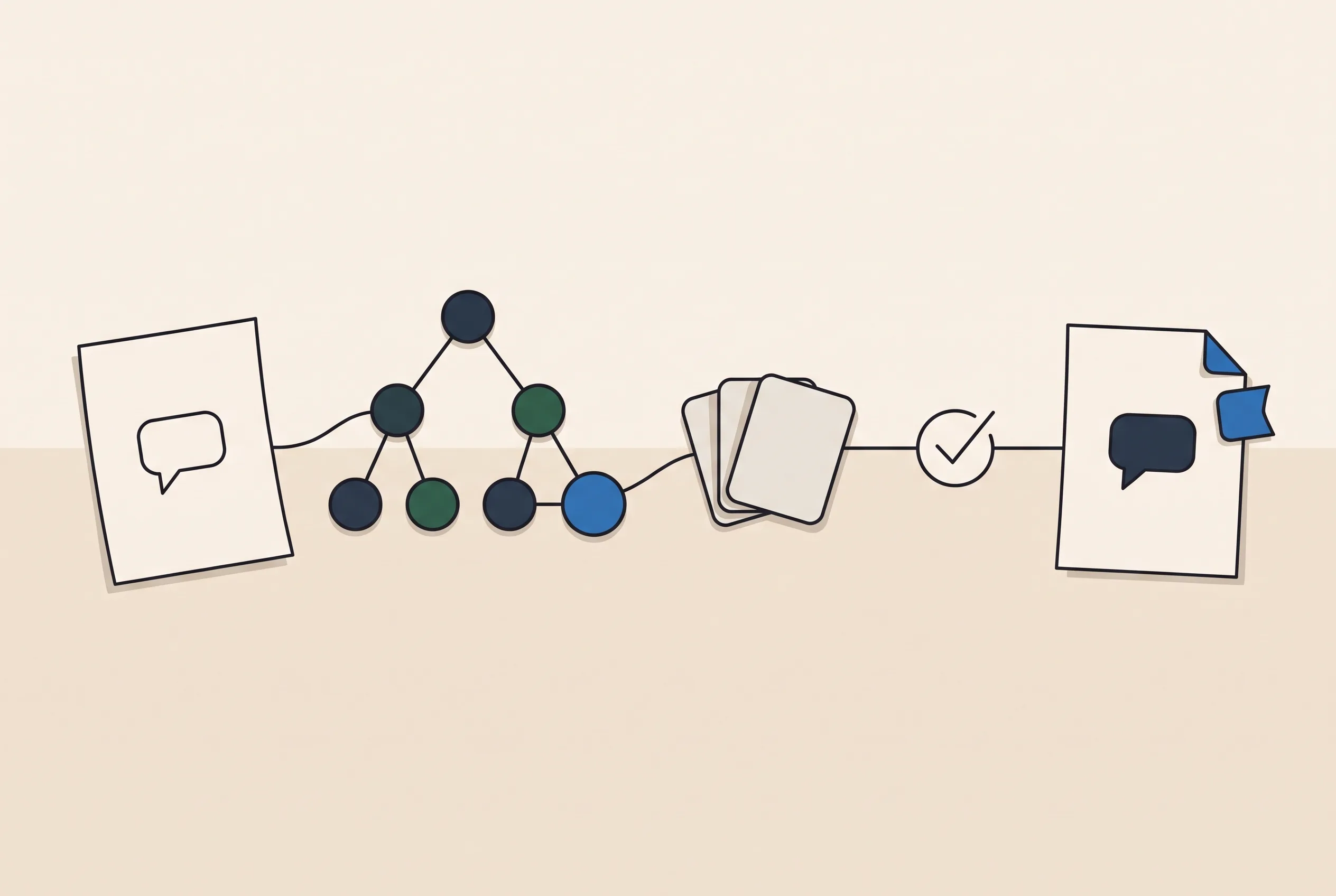
Regulations sit in a hierarchy: law beats regulation, later amendments beat earlier ones, specific exemptions beat general rules. Your Co-pilot knows the hierarchy for your corpus, so when two clauses conflict, it returns the one that governs the case in front of you.
A photo of an on-site condition goes to a vision model. A scanned PDF goes to OCR. A regulatory question goes to a text model with your corpus attached. You don't pick — the routing is invisible.
Every answer carries a clause reference. If the system can't find one, it says "I don't know" instead of fabricating. This is the difference between a research toy and something you can hand to a client, a committee, or a regulator.

We built Tzion for the Israeli market. He's live on WhatsApp today, used by consultants, architects, and lawyers.
Tzion covers 12 regulations, 8 standards, and the Israeli Equal Rights Commissioner's publications. He cites the source clause for every answer, refuses to answer without a source, and understands the applicability hierarchy — which is what makes him trustworthy for professional work. We'll build the same on your corpus.
Live in production. Hundreds of professional users. Cites every answer.
One free-text field. Describe the market and the body of regulation you want covered. We'll come back within two business days with a scope and a quote.